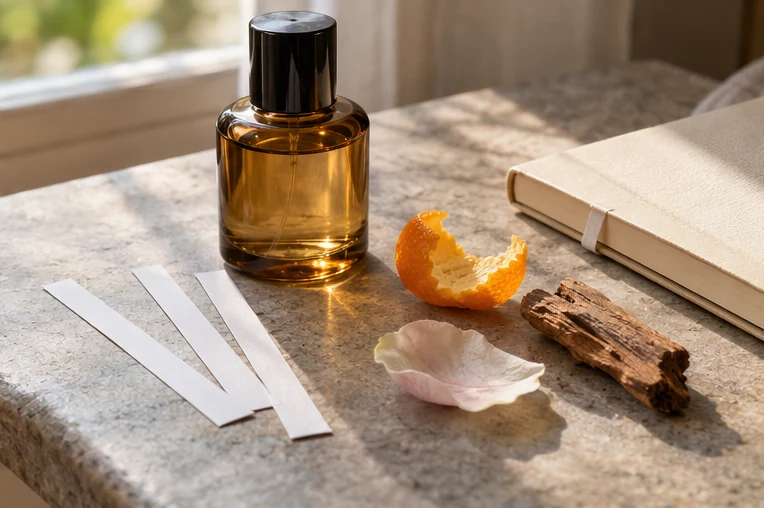
Top, middle and base are useful listening points for fragrance, but they are not a promise that every perfume unfolds neatly in three acts. Use the idea to make your own observations more consistent.
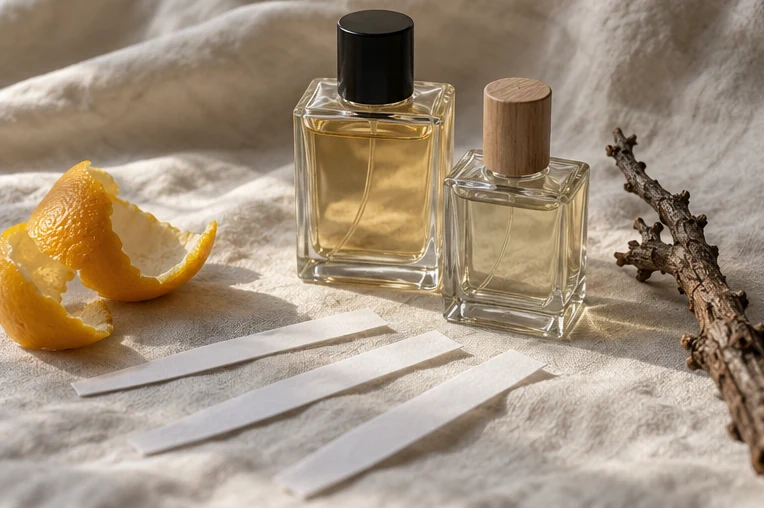
On an appropriate scent strip, note brightness, sweetness and any sharpness within the first few moments. Do not guess individual ingredients if you only detect a general impression.
02
Return to the heart
After the opening settles, notice which impression remains. Floral, fruity, spicy or herbal notes may appear together, and perceived transitions depend on the fragrance and wearer.
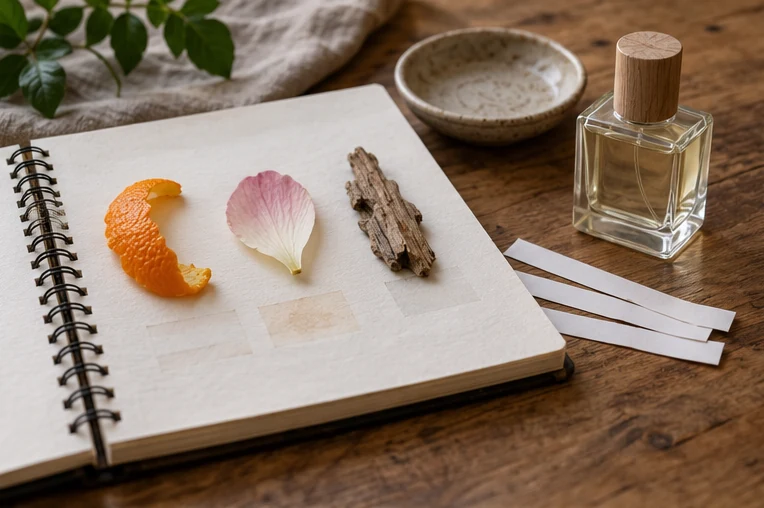
Write an impression before looking for a note.A personal observation map. These stages are prompts, not fixed evaporation times or proof of ingredients.Swipe the diagram to compare the details. With a keyboard, focus it and use the arrow keys.03
Observe what stays
Later impressions may be woody, powdery, musky or sweet. Record intensity as well as character; a persistent perfume is not automatically the most comfortable one.
04
Compare before layering
Understand each fragrance alone, then test a very restrained combination with suitable consumer products. Stop if the result becomes irritating or overwhelming.
An observation method and a three-stage scent card, rather than a formula for mixing ingredients.
AT YOUR WORKTABLE
Keep the impression in your own words.
Choose a direction and keep the details that matter to you.
Your notes are not saved after a reload. Download or print a copy to keep them.
A scent, over time
Write your impressions in your own words. Observation times are prompts, not a promise about a fragrance's behavior.